The Shift from Links to Identity
In the early days of SEO, we played a game of hide and seek with keywords. If you repeated a word enough times, Google would find you. But in 2026, the search landscape has shifted entirely. Google is no longer just a library of pages; it is an AI-driven Discovery Engine. It doesn’t just want to find your content; it wants to know who you are.
The secret to winning in this new era is becoming a Digital Entity. An entity isn’t just a website; it’s a recognized identity in Google’s brain. Think of it like a digital passport. If you have a verified passport, Google trusts you to provide answers in its AI Overviews (SGE). If you don’t, you are just background noise. This guide will show you how to build a brand identity that Google’s AI won’t just find, but will actually trust and recommend.
1. The Relationship Map: How AI Sees Your Brand
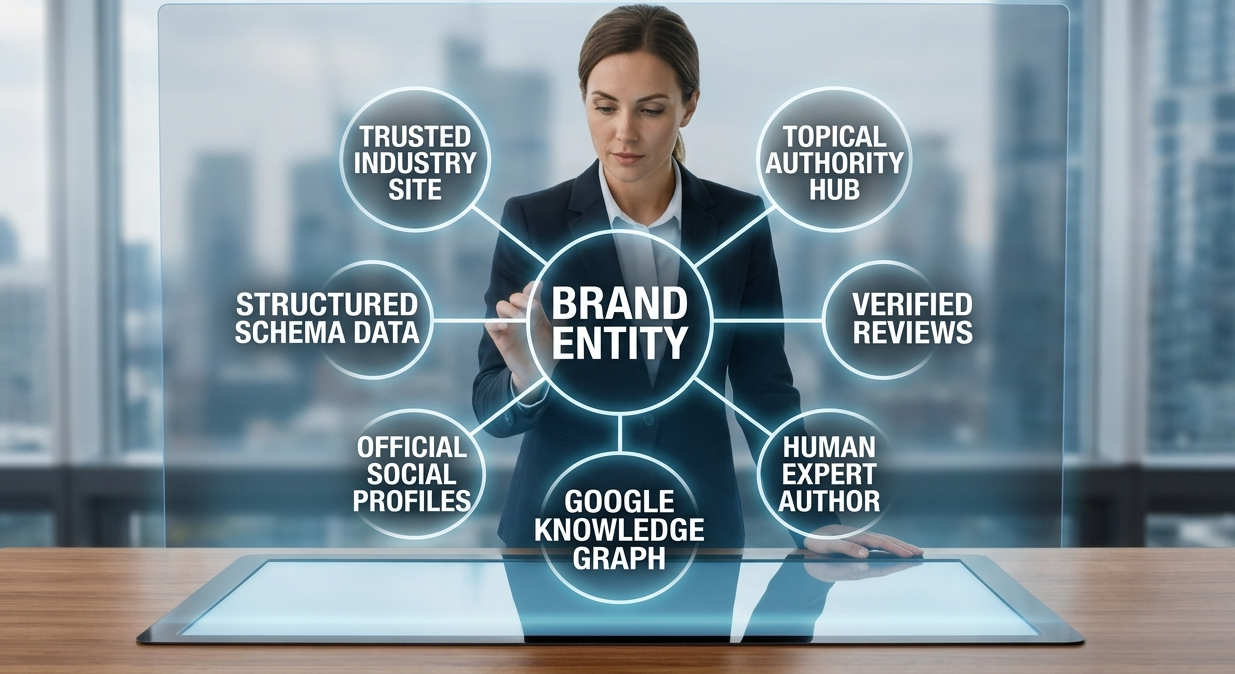
Google’s AI builds something called a Knowledge Graph. Imagine a massive, glowing map of the internet where every brand, person, and topic is a dot. Lines connect these dots to show relationships.
The “TechVanguard” Example:
Imagine you run a tech blog called TechVanguard. Google doesn’t just look for the word Tech on your site. Instead, its AI looks for lines connecting TechVanguard to other trusted entities. It wants to see a line connecting you to Artificial Intelligence, another line to “Silicon Valley News,” and a connection to “Verified Tech Reviewers.“
If your brand is a floating dot with no lines connecting it to other experts or topics, the AI assumes you are a ghost or a bot. In 2026, your primary SEO job is to build as many strong, relevant lines as possible between your brand and the established authorities in your niche.
2. Technical Entity Setup: The Language of Machines
You can’t just tell Google you are an authority; you have to prove it in a language the AI speaks. This language is Schema Markup.
Deep Schema Implementation
In 2026, basic Article schema isn’t enough. You need to use Entity-Deep Schema:
- Organization & Founder Schema:
Clearly define who owns the brand. Link the Founder property to the founder’s personal social media and professional profiles.
- The “SameAs” Property:
This is the most critical tag. It tells the AI:
“This website TechVanguard is the same entity as this YouTube channel and this verified LinkedIn page.“
It merges your fragmented identity into one powerful dot on the map.
- AreaServed & KnowAbout:
Use these tags to tell Google exactly what your expertise is and which geographic area or industry sector you dominate.
3. Topical Authority: Building the Expertise Pillar
AI models like Gemini love organization. If your content is scattered, the AI gets confused. To fix this, you must build Content Clusters.
Instead of writing 50 random blog posts, you should create a Topical Hub:
- The Pillar:
A 4,000-word Master Guide that covers every basic aspect of your main topic For example : “The Complete History and Future of AI Note-Taking”
- The Spokes:
20 smaller articles that answer hyper-specific questions
For Example : “Best AI Note-taker for Medical Students,” “How to Secure AI Data”
- The Connectivity:
Every Spoke must link to the Pillar, and the “Pillar“ must link to the “Spokes.“ This structure tells Google:
“This brand isn’t just writing articles; they own this entire topic.“
4. E-E-A-T: The Human Guardrail
With AI creating millions of fake articles every day, Google is desperate for Human Evidence. This is where E-E-A-T (Experience, Expertise, Authoritativeness, and Trustworthiness) becomes your best friend.
Proving You Are Human
- First-Hand Experience:
Use “I” and “We.” Share your specific failures and successes. AI can summarize facts, but it can’t tell a story about how a specific software crashed during a presentation and what you did to fix it.
- Original Research:
In 2026, one original survey or case study is worth 100 how-to articles. If you produce your own data, the AI will cite your brand as the primary source of truth.
- Transparency:
Your About Us page should show real faces, real office locations (even if remote), and real mission statements. An Entity needs a physical or social presence to be trusted.
5. Off-Page Entity Signals (Beyond Backlinks)
In the past, we wanted Backlinks. Today, we want Brand Mentions.
The Digital Footprint
The AI crawls the web to see how people talk about you.
- Sentiment Analysis:
If people on Reddit or X (Twitter) are praising your brand, Google’s AI notices. It measures Brand Sentiment.
- Unlinked Mentions:
Even if a news site doesn’t link to you, just mentioning TechVanguard in a positive context helps Google verify your entity status.
- Niche Participation:
Being cited in industry whitepapers or appearing on professional podcasts provides the AI with Audio and Visual proof that you are a real-world authority.
6. Writing for AI Summaries (The “Zero-Click” Strategy)
In 2026, many users get their answers directly from the AI Overview without clicking a link. You want your brand to be the one the AI quotes.
- The Inverted Pyramid Style:
Start your articles with a 2-3 sentence direct answer to the user’s question. This makes it easy for the AI to snip your content.
- Data Tables and Comparisons:
AI loves structured data. If you are comparing two products, use a table. If you are explaining a process, use a numbered list.
- Conversational Language:
Write how people talk. If your writing is too academic, it might not match the natural language queries people ask their AI assistants.
7. Multimodal Presence: Text is Not Enough
A true Digital Entity exists in multiple formats. Google’s AI is “multimodal,” meaning it understands text, images, and video simultaneously.
- Video Integration:
Every major blog post should have a short video summary. This gives the AI more data points to confirm your expertise.
- Custom Visuals:
Stop using stock photos. Use original charts, screenshots, and diagrams. When you create a unique image, Google’s Circle to Search and AI tools will attribute that image back to your brand.
Conclusion: The Goal is Being Un-Ignoreable
Winning in 2026 isn’t about chasing the algorithm; it’s about becoming so well-defined and so trusted that Google’s AI has no choice but to include you. By focusing on your Digital Entity, implementing deep Schema, and proving your Human Experience, you are future-proofing your business.
Don’t just be another website on the internet. Be a recognized authority. Be the dot on the map that everyone else is connected to.
What is the one specific topic your brand can “own” this year? Start building your entity around that core strength today.
Frequently Asked Questions
1. What is a Digital Entity in SEO?
A Digital Entity is a distinct, well-defined identity (like a brand or person) that Google recognizes as a specific “thing” rather than just a collection of keywords. It is the transition from “strings” of text to “things” with real-world relationships.
2. How does Google’s AI identify my brand?
Google uses its Knowledge Graph to connect your website with your social media profiles, physical address, founder’s name, and mentions on other authoritative websites. Using Schema Markup is the fastest way to help AI make these connections.
3. Why is “Topical Authority” more important than keywords in 2026?
AI models like Gemini prioritize brands that demonstrate deep knowledge across an entire subject. By covering a topic from every angle, you prove to the AI that you are a reliable expert, making it more likely to cite you in AI Overviews.
4. Can I still rank if I use AI-generated content?
Yes, but only if it is edited and enhanced with Human Touch signals. Google’s AI filters for E-E-A-T (Experience, Expertise, Authoritativeness, Trust). Purely automated content without original insights or personal experience often fails to gain entity status.
5. What is the most important technical step for Entity SEO?
Implementing Organization Schema with the sameAs property. This tells the AI exactly which social profiles and third-party listings belong to your brand, merging your digital footprint into one solid identity.