
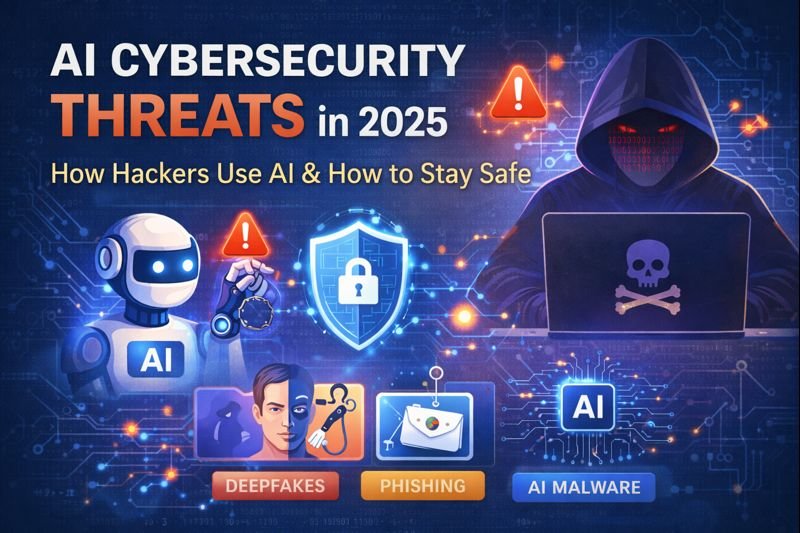
How Hackers Use AI and How to Stay Safe
Artificial Intelligence is changing the world at a rapid pace. While AI brings innovation and convenience, it also introduces serious cybersecurity threats. In 2025, cybercriminals are increasingly using AI to launch smarter, faster, and more dangerous attacks than ever before.
This article explores the biggest AI cybersecurity threats in 2025, how hackers use artificial intelligence, and what individuals, students, and businesses can do to stay safe.
Why AI Is a Growing Cybersecurity Risk
AI systems can analyze massive amounts of data, learn patterns, and automate tasks. Unfortunately, hackers use the same technology to:
- Automate cyberattacks
- Bypass security systems
- Create realistic phishing scams
- Develop advanced malware
- Exploit vulnerabilities faster
As a result, AI-powered cyberattacks are more difficult to detect and stop.
Top AI Cybersecurity Threats in 2025
Below are the most dangerous AI-driven cyber threats trending in 2025.
1.AI-Powered Phishing Attacks
Traditional phishing emails were easy to spot due to poor grammar. However, AI has completely changed this.
How It Works:
- AI analyzes user behavior
- Generates personalized phishing emails
- Mimics real writing styles
- Uses deepfake voices or videos
These attacks are highly convincing and extremely dangerous.
2.Deepfake Scams & Identity Theft
Deepfake technology uses AI to create fake images, videos, or voice recordings.
Common Uses by Hackers:
- Fake CEO voice calls
- Identity fraud
- Financial scams
- Blackmail and misinformation
Deepfakes are now one of the biggest cybersecurity challenges worldwide.
3.AI Malware & Self-Learning Viruses
AI-powered malware can:
- Change behavior to avoid detection
- Learn from security systems
- Automatically spread across networks
- Attack specific targets
Unlike traditional malware, AI malware adapts in real time.
4.Automated Password Cracking
Hackers use AI to:
- Analyze leaked passwords
- Predict password patterns
- Crack complex passwords faster
- Perform large-scale credential attacks
Weak passwords are no longer safe in the AI era.
5.AI-Based Social Engineering Attacks
Social engineering attacks manipulate human psychology. AI makes them more effective by:
- Analyzing social media profiles
- Predicting emotional responses
- Creating believable fake conversations
This leads to higher success rates for scams.
6.AI Attacks on Cloud Systems
As businesses move to cloud platforms, AI attackers target:
- Cloud storage
- APIs
- SaaS platforms
- AI models themselves
Cloud security is now a major concern in cybersecurity.
Why Traditional Cybersecurity Is Not Enough
Old security systems rely on fixed rules. AI attacks, however:
- Evolve constantly
- Learn from failures
- Bypass signature-based detection
- Exploit zero-day vulnerabilities
This makes AI vs AI cybersecurity defense essential in 2025.
How AI Is Also Used to Defend Against Cyber Threats
The good news is that cybersecurity experts also use AI.
AI-Based Cyber Defense Includes:
- Real-time threat detection
- Behavioral analysis
- Automated response systems
- Predictive security alerts
AI-powered security tools help detect threats faster than humans.
Best Cybersecurity Practices to Stay Safe in 2025
Here are practical tips everyone should follow:
1. Use Strong & Unique Passwords
- Use password managers
- Avoid repeating passwords
- Enable two-factor authentication (2FA)
2. Be Alert to AI Phishing
- Check email sources carefully
- Avoid clicking unknown links
- Verify messages before acting
3. Keep Software Updated
- Update operating systems
- Patch security vulnerabilities
- Use official software only
4. Learn Cyber Awareness
Education is the strongest defense. Understanding cyber risks reduces mistakes.
5. Use AI-Based Security Tools
Modern antivirus and security platforms use AI to detect threats early.
Impact of AI Cyber Threats on Students & Freelancers
Students and freelancers are major targets because:
- They use multiple platforms
- Often reuse passwords
- Store sensitive academic and financial data
Learning basic cybersecurity skills is now essential for everyone.
AI, Cybersecurity & the Future
In the future, we can expect:
- AI vs AI cyber battles
- Stronger regulations
- Ethical AI security standards
- Advanced identity verification systems
Cybersecurity will become a core digital skill, just like computer literacy.
Ethical Concerns of AI in Cybersecurity
AI cybersecurity raises concerns such as:
- Privacy violations
- Surveillance misuse
- Bias in security systems
- AI accountability
Governments and organizations must balance security with ethics.
AI Cybersecurity Trends to Watch in 2025
Zero Trust Security Models
AI-driven SOC systems
Deepfake detection tools
AI-powered threat intelligence
Cybersecurity automation
These trends will shape the future of digital safety.
Final Thoughts
AI is a powerful tool ,but in the wrong hands, it becomes a serious threat. The AI cybersecurity threats of 2025 are more advanced, more convincing, and more dangerous than ever before .Ai is also helpful in many ways like it can help us making money online .
However, by understanding these risks and adopting smart security practices, individuals and organizations can stay protected. The future of cybersecurity depends on awareness, education, and responsible AI use .if you want to read more about cybersecurity click here>> what is cybersecurity.