

Welcome to the grand finale of our initial series at the Research Skill Center. We have traveled a long road together. From understanding the core of AI in Lecture 01 to mastering the “detective” skills of fact-checking in Lecture 04, you now have the raw materials of a professional researcher.
But here is the hard truth: Raw research is like crude oil. It is valuable, but you cannot put it in a car and expect it to run. You must refine it. In Lecture 05, we are learning the “Refinery Process” AI Content Optimization. We will turn your verified data into a high-ranking, readable, and human-centered WordPress post that Google’s algorithms will love.
The Psychology of the Digital Reader (The F-Pattern)
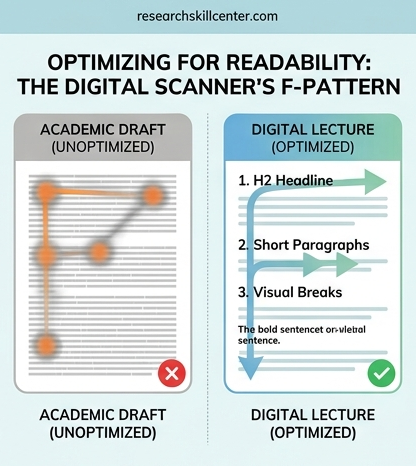
Before we look at keywords, we must look at the human eye. Research shows that online readers do not read word-for-word like they do with a physical book. Instead, they scan in an F-shaped pattern:
- They read the Main Headline (H1).
- They scan the Sub-headings (H2s).
- They look for Bullet Points and Bold Text.
If your AI-generated research looks like a Wall of Text (long, dense paragraphs), the reader will leave within 5 seconds. In SEO terms, this is a Bounce. If too many people bounce, Google will demote your page, thinking it isn’t helpful. Optimization is the art of making your content Scannable.
1. The Structural Framework: Architecting Your Post
To optimize for both Google and Humans, your lecture must follow a strict hierarchical structure. Think of it as a house: the H1 is the roof, H2s are the walls, and H3s are the furniture.
The Power of H2 and H3 Tags
Google uses Header Tags to understand what your post is about.
- H1 (The Big Promise): Must contain your Focus Keyphrase
For Example
AI Content Optimization.
It should be catchy, like:
Mastering AI Content Optimization for 2026. - H2 (The Main Pillars): These should be the main steps of your lecture. If a student only reads your H2s, they should still learn the gist of the lesson.
- H3 (The Details): Use these to break down complex instructions within an H2 section.
The 3-Sentence Rule for Paragraphs
In mobile-first SEO, white space is your friend.
- Large paragraphs are physically painful to read on a smartphone.
- The Rule: Never write a paragraph longer than 3 or 4 sentences.
- Give the reader’s eyes a “rest” by hitting the Enter key frequently.
2. Technical On-Page SEO: Speaking to the Algorithm
Now, let’s look at the technical switches you need to flip in WordPress (using Rank Math or Yoast) to ensure search engine visibility.
Focus Keyphrase Optimization
Your primary keyword (AI Content Optimization) isn’t just a label; it’s a signal. Place it strategically:
- The First 100 Words: Google gives more weight to keywords found at the beginning of the post.
- The URL Slug: Keep it clean. Instead of ?p=123, use ai-content-optimization-guide.
- Image Alt Text: Describe your images using the keyword naturally.
LSI (Latent Semantic Indexing) Strategy
In 2026, Google will be smarter. It looks for Contextual Keywords (LSI). If you are writing about AI Optimization, your post should naturally include terms like:
- Search Intent
- User Experience (UX)
- Readability Score
- On-Page SEO Framework
- Semantic Search
Pro-Tip: Do not stuff keywords. If it feels forced, delete it. Google penalizes “Keyword Stuffing because it ruins the user experience.
3. The Human-Touch: Refining the AI Voice
Raw AI output often feels “sterile” or “robotic.” It uses too many “In conclusion” and “Furthermore” phrases. To rank well, you must Humanize the output.
| AI Phrase to Avoid | Human Alternative | Why? |
| In the rapidly evolving landscape. | Today’s world is changing fast. | Less fluff, more direct. |
| It is important to note that. | Remember this: | Stronger connection. |
| Utilize | Use | Simple English is better for SEO. |
| Delve into | Look at or Explore | AI-isms sound fake. |
Vary Your Sentence Length
AI loves a steady, medium-length rhythm. Humans love variety.
- Use a short, punchy sentence for impact. Like this.
Then, follow it with a longer, descriptive sentence that explains the logic behind your claim. This rhythm keeps the reader engaged.
4. WordPress Workflow: From Draft to Published Asset
When you move your research into the WordPress Editor (Gutenberg), follow this 10-Point Checklist:
- Clear Formatting: Paste your AI text into a notepad first to strip away hidden junk code that can slow down your site.
- Featured Image: Use a high-quality, relevant image with your focus keyword in the Alt Text.
- Internal Links: Link back to Lecture 02 (Prompting) and Lecture 04 (Fact-Checking). This builds a “Silo” that boosts your overall site authority.
- External Links: Link to one authority site like Search Engine Journal or Google Search Central to show your research is backed by experts.
- Table of Contents: Use a plugin to add a clickable TOC at the top. Google often shows these as Sitelink in search results.
- Bullet Points & Numbered Lists: Use these for any process or list. They are SEO gold.
- Blockquotes: Highlight a Key Takeaway in a blockquote to make it stand out.
- Meta Description: Write a custom 150-character summary that makes people want to click.
- Mobile Preview: Always check how the post looks on a phone. If it looks cluttered, add more headings.
- The Call to Action (CTA): At the end, ask a question or give an assignment. Engagement (comments) is a huge SEO signal.
5. Visual Integration: Making Data Pop
We will add three specific infographics to this lecture to break up the text:
- The SEO Anatomy Map: A screenshot of a WordPress post showing exactly where the H1, H2, and Keywords go.
- The Readability Scale: A visual comparing Grade 12 Level writing (Bad for web) vs. Grade 7 Level writing (Good for web).
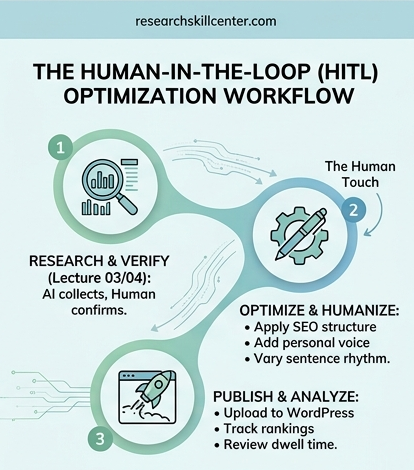
- The Final Workflow Loop: A diagram showing the full process: Research ⮕ Verify ⮕ Optimize ⮕ Publish.
Summary and The Final Project Assignment
Optimization is not about tricking Google. It is about making your high-quality research as accessible as possible. If a reader can find your answer quickly and understand it easily, Google will reward you with the #1 spot.
Your Final Assignment:
- Pick one piece of research you did in this course.
- Create a New Post in WordPress.
- Apply the 3-Sentence Rule and the H2/H3 Hierarchy.
- Use Rank Math to get an SEO score of 80+.
- Publish it and share the link in our Research Skill Center community for a final peer review!
Congratulations! You have completed the AI Research Mastery series. You are now equipped to lead in the age of AI.
FAQs
1. Why is the “F-Pattern” important for AI-generated content?
Ans: Most digital readers don’t read every word; they scan in an F-shape. If your AI content is just a long block of text, readers will miss the key points and leave. Structuring with H2/H3 headers and bullet points ensures they find the value quickly.
2. Does Google penalize content just because it was written by AI?
Ans: No. Google’s 2026 guidelines focus on Helpful Content (E-E-A-T). If your AI-generated research is accurate, well-formatted, and provides a good user experience, it will rank. It only penalizes “low-effort” AI content that is repetitive or unverified.
3. What is the “3-Sentence Rule” for WordPress readability?
Ans: Mobile screens are small. A paragraph that looks short on a laptop can look like a “brick” on a phone. By keeping paragraphs to 3 sentences maximum, you increase white space, which makes the reading experience much more comfortable and reduces your bounce rate.
4. How do I choose the best Focus Keyphrase for my research?
Ans: Your Focus Keyphrase should be the answer to what your target audience is searching for. Use a tool like Google Keyword Planner to find a phrase with high volume but manageable competition, and ensure it appears in your Title, first paragraph, and Slug.
5. What are “AI-isms” and why should I remove them?
Ans: AI-isms are repetitive phrases like In the rapidly evolving landscape or Delve into. These make your writing sound robotic. Removing them and adding personal pronouns (I, We, You) gives your content a Human-Touch that builds trust with your audience.