
Welcome back to the Research Skill Center. In our previous session, Lecture 01, we introduced the essential AI tools like Perplexity and Claude. We learned that while these tools are powerful, they are just like a library useless unless you know how to ask for the right book.
Today, we are moving into Lecture 02: Advanced Prompt Engineering. Many students make the mistake of treating AI like a simple search engine (Google). They type one sentence and expect a perfect essay or report. When the AI gives a robotic or generic answer, they get frustrated. Today, I will teach you how to “Talk to AI” using professional frameworks. We will learn how to turn a basic, weak instruction into a Master Prompt that produces high-quality, human-like, and academically sound work.
The Core Concept: Moving from Asking to Engineering
Think of an AI as a very smart intern who has read every book in the world but has zero common sense. If you tell an intern, “Write me a report on pollution,” they might give you 5 pages of children’s science facts. But if you say, “Write a technical analysis of air quality in the Pakistan council meeting,” the result will be completely different.
This is the difference between Asking and Engineering. Engineering means you are building a structure for the AI to follow. This ensures the output isn’t just “AI-generated” but is “Student-directed.”
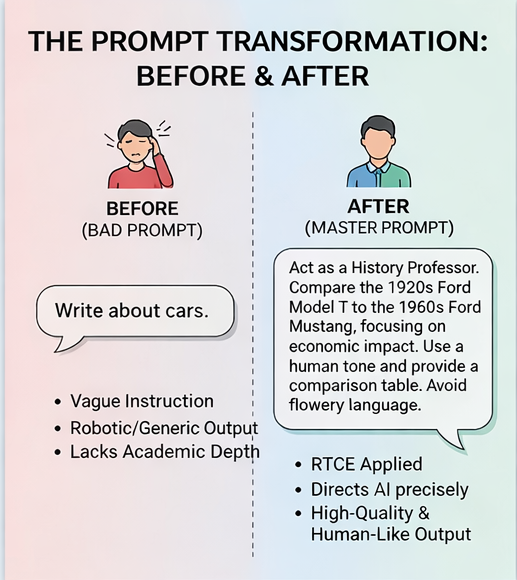
1. The R-T-C-E Framework: Your Secret Formula
To get a professional result, every prompt must have these four parts. Let’s use a History Assignment as an example instead of SEO:
Role (R): Who should the AI be?
- Example: Act as a History Professor with a PhD in Ancient Civilizations.
Task (T): What exactly do you want?
- Example: Compare the irrigation systems of Ancient Egypt and the Indus Valley.
Context (C): Who is this for and what is the background?
- Example: This is for a university-level research paper. Focus on the economic impact of these systems.
Expectation (E): How should it look?
- Example: Use a formal tone, provide a bulleted summary of differences, and do not use generic AI introductions.
Master Prompt Result:
“Act as a History Professor. Compare the irrigation systems of Ancient Egypt and the Indus Valley for a university research paper. Focus on economic impacts, use a formal tone, and provide a clear comparison table. Avoid flowery language.”
2. Chain-of-Thought (CoT): Teaching the AI to Think
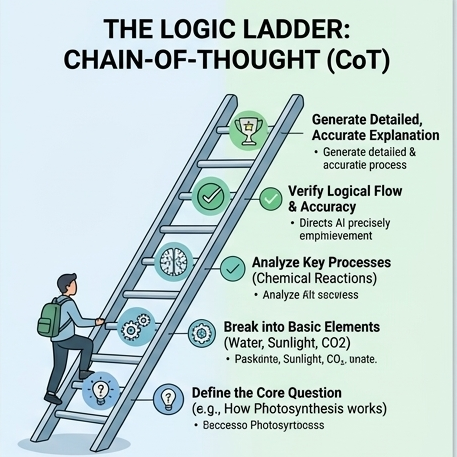
Sometimes, AI jumps to a conclusion too fast and makes mistakes in logic (especially in Math or Science). Chain-of-Thought is a technique where you force the AI to solve a problem step-by-step.
How to use it (General Example): If you are asking the AI to solve a complex physics problem or explain a difficult concept like “Photosynthesis,” don’t just ask for the definition.
Add this phrase: “Explain this concept step-by-step, starting from the basic elements to the final result, and check each step for logical accuracy.”
By doing this, the AI doesn’t just “guess” the answer; it builds it. For a student, this makes the explanation much easier to study and learn from.
3. Few-Shot Prompting: Making it Sound Like YOU
The biggest problem with AI is that it sounds like a machine. To Humanize the response, use Few-Shot Prompting. This means giving the AI a “sample” of your own work first.
Step 1: Copy a paragraph you wrote yourself (maybe an old assignment).
Step 2: Tell the AI: “Below is a sample of my writing style. Notice how I use short sentences and simple words. Now, using this exact style, explain the causes of the French Revolution.”
This ensures the AI doesn’t use words like “tapestry” or “delve” that make teachers suspicious. It keeps your work sounding natural and personal.
4. Eliminating the “AI Signature” (Writing Refinement)
Professional academic writing is direct and clear. AI writing is often “fluffy” (using too many unnecessary words). Use these Negative Constraints to clean up the output:
- Instruction: “Do not use clichés or overused AI words like ‘unlock,’ ‘unleash,’ or ‘in today’s fast-paced world’.”
- Instruction: “Keep the reading level suitable for a 1st-year University student.”
- Instruction: “Focus on facts and data rather than emotional adjectives.”
Conclusion and Assignment
Advanced Prompt Engineering is about Control. You are the captain of the ship; the AI is just the engine. If you give clear, structured instructions, you can produce work that is not only faster but also much higher in quality than anyone else in your class.
Your Assignment:
- Think of a difficult topic from your current studies (e.g., “How a battery works” or “The causes of World War 1”).
- Ask the AI a simple 5-word question about it.
- Now, use the RTCE Framework to write a Master Prompt for the same topic.
- Compare the two. You will see that the second one is much more useful for your actual learning.
Next Lecture: Lecture 03: Autonomous AI Agents – How to let AI do your research while you sleep. Previous Lecture: Lecture 01: The Essential AI Research Toolkit.