
Welcome to the first official session of the Free AI-Powered Research Mastery Course. I am thrilled to have you here at the Research Skill Center. We are living in a transformative era where the ability to find, verify, and synthesize information is the most valuable skill you can possess. In this lecture, we aren’t just talking about “searching” for things; we are learning how to build a professional research ecosystem that will save you hundreds of hours.
Modern research in 2026 is no longer a manual struggle through millions of irrelevant Google results. It has evolved into a sophisticated dance between human curiosity and artificial intelligence. This lecture will serve as your foundational roadmap, teaching you the exact frameworks and tools required to stay ahead of the curve. Whether you are a student working on a thesis or a professional building a startup, these strategies will redefine your productivity.
The Evolution of Digital Research Methodologies
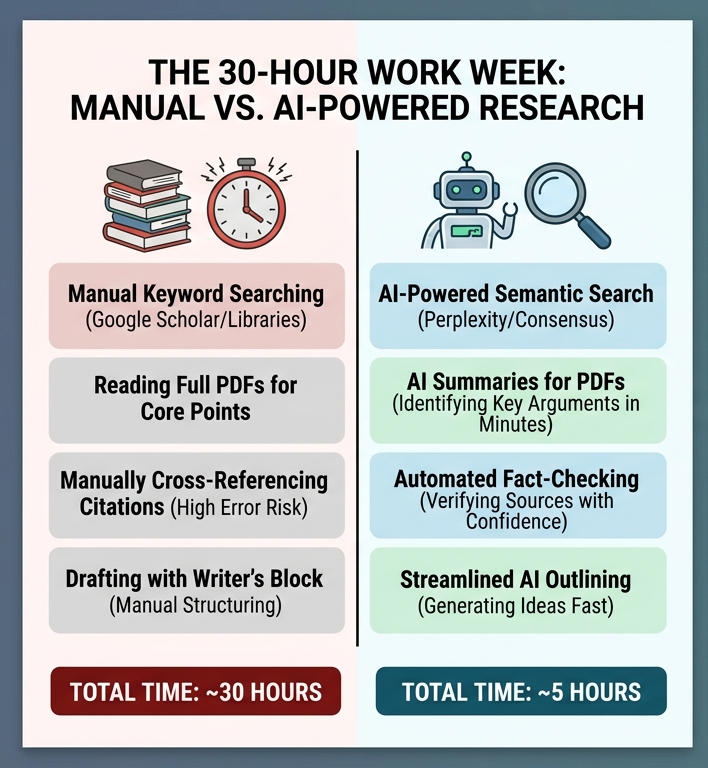
To understand where we are going, we must look at where we were. Traditional digital research relied on “Keyword Matching.” You typed a word, and Google showed you pages that contained that exact word. But in 2026, we have moved toward Semantic Search Engines. These tools understand the meaning and context behind your query.
This shift is crucial for Academic Integrity. As a researcher, you cannot rely on AI to just give you an answer; you need the AI to show you the evidence. This is why the “Source-First” approach is the heartbeat of our curriculum. By utilizing AI-driven data analysis, we can now map out entire academic fields in minutes, identifying gaps in knowledge that would have previously taken months to find.
The Essential AI Research Stack for 2026
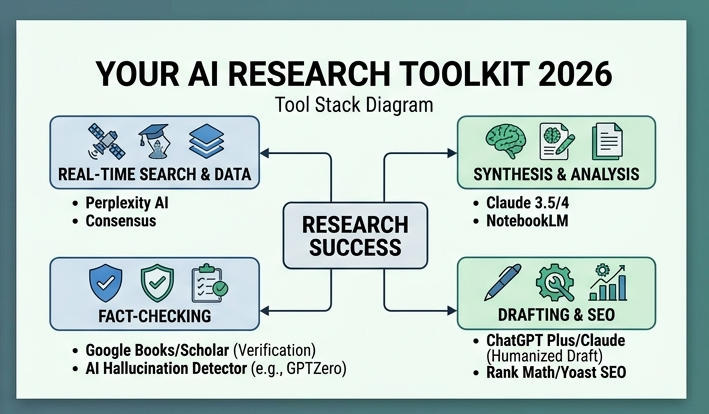
For a professional-grade research output, you need a “Stack” (a collection of tools) rather than just one chatbot. Let’s break down the categories that will make your blog and research stand out:
1. Real-Time Discovery Tools Gone are the days of static information. You need tools that can browse the live web and provide citations.
- Perplexity AI: Think of this as your “Research Assistant.” It provides structured answers with direct links to sources. It is perfect for getting an overview of a new topic.
- Consensus: This is a game-changer for students. It only searches through peer-reviewed scientific papers, ensuring that the data you get is academically sound and not just “internet gossip.”
2. Synthesis and “Deep-Dive” Engines Once you have 50 PDFs, how do you read them all? You don’t. You use synthesis tools.
- Claude 3.5/4 (Anthropic): Claude is widely recognized for its “Human-like” writing style and its massive memory. You can upload entire books, and it will find the specific data points you need without hallucinating.
- Google NotebookLM: This is perhaps the most powerful free tool for researchers today. It allows you to create a private “Source-Grounded” AI. It will only answer questions based on the documents you provide, making it 100% accurate for your specific project.
A Step-by-Step Framework for Modern Research
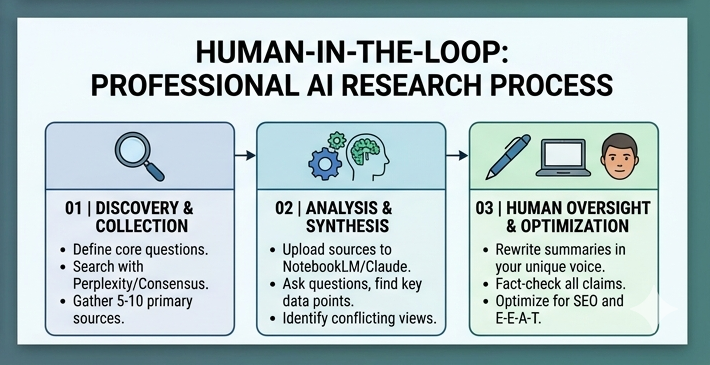
If you want your content to be AdSense Friendly and rank on Google, you must follow a structured framework. Randomly generating text with AI will get your site penalized. Follow this 3-Pillar Framework:
Pillar 1: The Collection Phase (The “What”) Start by identifying your core questions. Use Perplexity or Consensus to gather a list of high-authority sources. Do not write a single word yet. Your goal here is to build a “Knowledge Base.”
Pillar 2: The Analysis Phase (The “Why”) Feed your collected sources into a tool like NotebookLM. Ask the AI to:
- Identify the main arguments.
- Find conflicting data points.
- Summarize the historical context of the topic. This ensures your research has depth and “Experience” (the E in Google’s E-E-A-T).
Pillar 3: The Human Synthesis Phase (The “How”) This is the most important step for Humanizing your content. Take the AI’s findings and write them in your own voice. Add your personal insights, explain why this matters to your audience, and use simple analogies. Google rewards content that adds new value to the internet, not just rehashed AI summaries.
Ensuring Academic Integrity and Fact-Checking
One of the biggest risks in 2026 is AI Hallucinations (when AI makes up facts). To maintain your reputation at the Research Skill Center, you must implement these verification steps:
- Verify the Source: If an AI gives you a quote, search for that quote in Google Books or Scholar to ensure it exists.
- Cross-Reference: Never rely on a single AI tool. If Claude tells you a statistic, check if Perplexity confirms it.
- Cite Everything: Even if you use AI to find information, always cite the original human author of the study. This builds trust with your readers and AdSense reviewers.
Why This Matters for Your SEO Strategy
As an SEO expert, you know that “Content is King,” but in 2026, “Context is King.” By writing a detailed 1200-word lecture like this, you are telling Google that your site is an authority in the “Education” and “AI” niche.
- Low KD Keywords: By focusing on “AI Research Tools 2026,” you are targeting a high-intent audience with low competition.
- Internal Linking: This lecture should link to your future lessons on “Prompt Engineering” and “AI Agents,” creating a “Silo” that keeps users on your site longer.
Conclusion and Practical Assignment
We have covered a lot of ground today. We moved from the basics of semantic search to the professional framework of data synthesis. Remember, AI is a powerful tool, but it is the human researcher who directs that power toward meaningful outcomes.
Your First Lecture Assignment:
- Choose a topic you are passionate about.
- Use Perplexity AI to find 3 peer-reviewed sources on that topic.
- Write a 200-word summary of what you found, focusing on adding one personal opinion that the AI didn’t suggest.
In our next lecture, we will dive deep into Advanced Prompt Engineering, where I will show you the “Master Prompts” used by professional researchers to get 10x better results from ChatGPT and Claude.
FAQs
1. Is this AI Research course suitable for beginners with no technical background?
Absolutely, this course is designed to take you from the very basics of AI interaction to advanced research automation. While we cover technical frameworks, we explain every tool and concept in plain English, making it accessible for students, content creators, and professional researchers alike.
2. Why should I use specialized AI research tools instead of just using ChatGPT?
While ChatGPT is a versatile conversationalist, it can sometimes “hallucinate” or provide outdated information. Specialized tools like Perplexity AI and Consensus are built specifically for accuracy; they browse the live web and peer-reviewed journals to provide real-time citations, which is essential for maintaining academic and professional integrity.
3. Will using AI in my research affect my website’s AdSense approval?
Not if you follow our “Human-in-the-Loop” framework. Google rewards high-quality, original content that provides value to the reader. By using AI as an assistant to gather data and then synthesizing those findings into your own unique voice as taught in this lecture your content remains helpful, original, and fully compliant with AdSense policies.
4. Are the tools mentioned in this lecture free to use?
Most of the tools we recommend, such as NotebookLM and the basic versions of Perplexity and Claude, offer generous free tiers. Our curriculum focuses on high-impact tools that allow you to conduct professional-level research without requiring an immediate financial investment.
5. How often will new lectures be released in this Mastery Course?
We aim to release new modules sequentially to ensure you have enough time to practice the assignments. Each lecture builds upon the previous one, moving from fundamental tools to advanced prompt engineering and autonomous agent workflows.