
Welcome back to the Research Skill Center. In our previous session, Lecture 02, we mastered the art of Advanced Prompt Engineering. We learned how to move away from simple chatting and instead use structured frameworks like RTCE and Chain-of-Thought to control AI output. By now, you should be comfortable directing an AI to think and write exactly like a professional researcher.
Today, we are taking a massive leap forward in Lecture 03: Autonomous AI Agents. Up until now, you have been the one doing the heavy lifting writing the prompts, copying the data, and guiding the conversation. But what if the AI could think for itself? What if you could give it a goal, and it figured out the steps, did the research, and compiled the report while you were away from your desk? That is the power of Autonomous AI Agents like AutoGPT and AgentGPT.
The Shift from Chatbots to Autonomous Agents
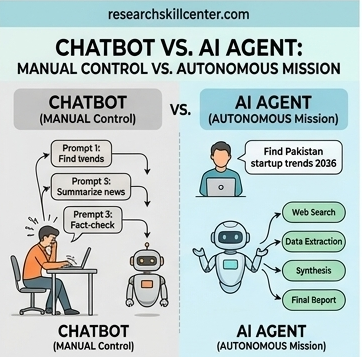
To understand Autonomous Agents, think of the difference between a remote-controlled car and a self-driving car.
A Chatbot like ChatGPT is a remote-controlled car; it only moves when you press a button to give a prompt.
An Autonomous Agent is the self-driving car; you give it a destination, and it navigates the traffic, makes turns, and finds the best route on its own.
In the world of research, an agent doesn’t just answer your question. It creates its own To-Do List, searches the internet, reads multiple websites, fact-checks itself, and summarizes the findings into a final document. This is the future of Automated Data Collection.
How Autonomous Agents Work: The Loop of Logic
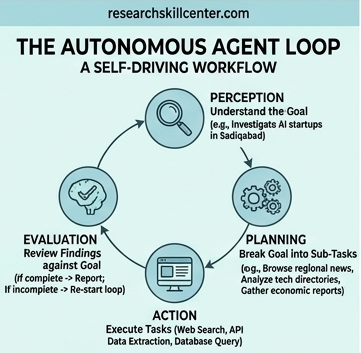
Most agents operate on a continuous loop of four stages. Understanding this loop is key to managing them effectively:
Perception: The agent looks at the goal you provided
For Example Find the top 10 startup trends in Pakistan for 2026
Planning: It breaks that goal into smaller tasks
For Example
1. Search Google
2. Visit local news sites
3. Analyze economic reports
Action: It executes the tasks, such as browsing the web or using APIs.
Evaluation: It looks at what it found and asks, Does this satisfy the user’s goal? If not, it starts the loop again until the job is done.
Top Tools for Autonomous Research
You don’t need to be a programmer to use these agents. In 2026, several user-friendly platforms allow you to deploy agents in seconds:
AgentGPT / Godmode.space:
These are web-based platforms where you can simply name your agent and give it a mission. They are perfect for students and startups who want quick market research or literature reviews.
AutoGPT:
A more powerful, local version that can access your computer’s files and perform complex operations. It is the gold standard for heavy-duty data collection.
BabyAGI:
A simplified version focused on task management and prioritization.
The Human-in-the-Loop: Why Agents Still Need You
It is tempting to think you can just set it and forget it, but for high-quality academic and technical work, the Human-in-the-Loop (HITL) model is essential. Agents can sometimes go down rabbit holes or collect data from unreliable sources.
How to stay in control:
Set Clear Boundaries:
Tell your agent which websites to trust and which to avoid.
Intermediate Checks:
Review the agent’s To-Do List before it starts the execution phase.
Synthesis:
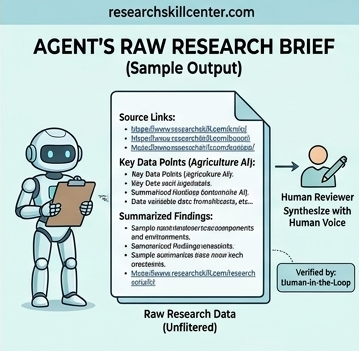
Never publish an agent’s raw output. Use the data it collected as a Research Brief, then use your own voice as we learned in Lecture 02 to write the final piece.
Visuals and Diagrams for this Lecture
To help your students visualize these advanced concepts, I recommend adding these three images:
1. The Human vs. Agent Comparison
Visual:
A side-by-side illustration. One side shows a person manually typing prompts (The Chatbot Method). The other side shows a person setting a “Goal” and a robot figure handling multiple tasks simultaneously (The Agent Method).
Placement:
After the Shift from Chatbots to Autonomous Agents section.
2. The Autonomous Loop (Infographic)
Visual: A circular diagram showing the Perception ⮕ Planning ⮕ Action ⮕ Evaluation loop.
Placement:
In the How Autonomous Agents Work section.
3. The Research Brief Sample
Visual:
A screenshot or mock-up of what an agent’s output looks like a structured list of links, data points, and summaries, labeled as Raw Research Data.
Placement:
Near the Human-in-the-Loop section.
Summary and Practical Assignment
Autonomous AI Agents are the ultimate productivity hack for the modern researcher. They allow you to scale your work by handling the repetitive parts of data collection, leaving you more time for critical thinking and creative writing.
Your Assignment:
1. Go to a free platform like AgentGPT or Godmode.space.
2. Create an agent named Market Explorer.
3. Give it the goal: Find 5 emerging AI startups in the agriculture sector and summarize their core technology.
4. Watch the agent create its own tasks and collect the data. Save the final report for our next session.
FAQs
1. What is the fundamental difference between a Chatbot and an AI Agent?
Ans : Chatbot (Manual): Requires a new prompt for every single step. It is like a digital typewriter.
AI Agent (Autonomous): You give it one “Goal,” and it creates its own “To-Do List” to achieve it. It is like a digital employee.
2. Is coding knowledge required to use Autonomous Agents like AgentGPT?
Ans : No. Most modern platforms (AgentGPT, Godmode.space) are “No-Code” tools. You simply type your mission in plain English, and the agent handles the technical execution in the background.
3. Why do AI Agents sometimes get stuck in a “Loop”?
Ans : This happens when a goal is too broad or the agent hits a website it cannot read. To fix this, provide Clear Constraints (e.g., “Limit your search to 5 specific websites”) to keep the agent focused.
4. Can an Autonomous Agent replace a human researcher entirely?
Ans: No. Agents are excellent at Data Collection (finding facts), but they lack Critical Thinking (understanding the “Why”). A human is always needed to verify the data and write the final synthesis to ensure it is accurate and human-toned.
5. How can I ensure the data collected by an Agent is accurate?
Ans : Use the Human-in-the-Loop model. Always ask the agent to provide “Source Links” for every claim it makes. You must manually check at least 20% of those links to ensure high academic integrity.