
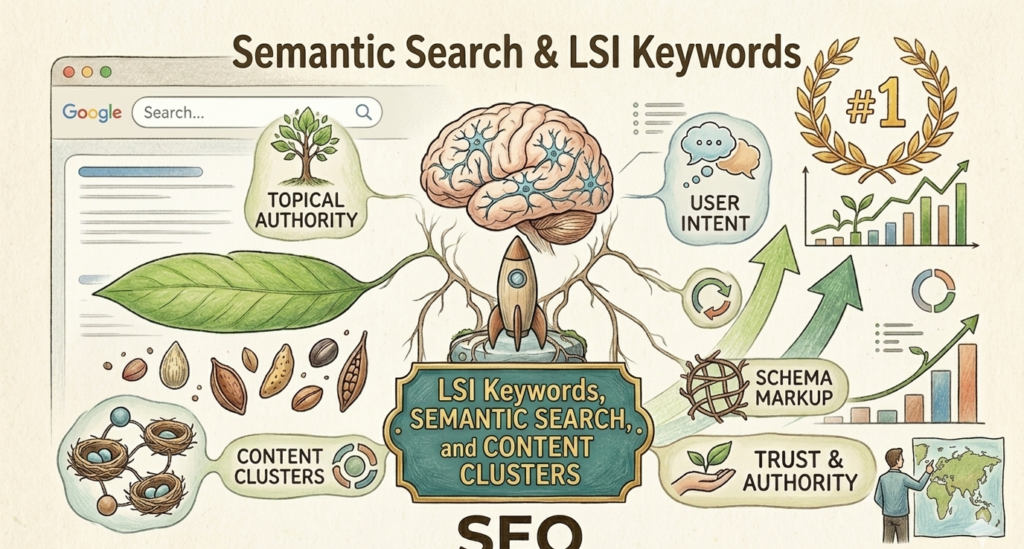
The era of keyword stuffing is long gone. Today, Google doesn’t just look at the words you type; it looks at the intent and the context behind them. This shift toward semantic search has opened a massive door for content creators: the ability to rank on the first page without relying solely on high-authority backlinks.
By mastering Latent Semantic Indexing (LSI) and semantic clusters, you can prove to search engines that your content is the most comprehensive resource available. This guide explores the technical and creative blueprint for using advanced semantic SEO to dominate the SERPs, even on a fresh domain.
1. Understanding Semantic SEO vs. Traditional Keywords
Traditional SEO focuses on a single target keyword. You find a high-volume term, place it in your H1, and hope for the best. Semantic SEO, however, focuses on topics.
Google’s Hummingbird and BERT updates changed the game by allowing the algorithm to understand the relationship between words. Semantic SEO is the process of building a web of meaning around your primary subject. When you cover a topic so deeply that you answer questions the user hasn’t even asked yet, Google rewards you with Topical Authority.
2. What Exactly Are LSI Keywords?
LSI (Latent Semantic Indexing) keywords are conceptually related terms that search engines use to deeply understand the content on a webpage.
Important Distinction: LSI keywords are not just synonyms.
For example, if your main keyword is Apple, LSI keywords like iPad, Steve Jobs, and iOS tell Google you are talking about the tech giant. LSI keywords like orchard, cider, and Vitamin C tell Google you are talking about the fruit. Without these related terms, the algorithm might struggle to categorize your page accurately.
3. The No Backlink Strategy: Why Topical Authority Wins
Backlinks act as votes of confidence, but topical authority is a certificate of expertise. If your website covers SEO for Startups better than any other site addressing every sub-topic, definition, and technical nuance Google will eventually trust your expertise more than a site that has backlinks but thin, fragmented content.
To rank without backlinks, your content must be:
- Comprehensive:
Covering the What, Why, and How.
- Relevant:
Using terms that naturally co-occur with the main topic.
- Structured:
Organized in a way that bots can easily map the relationships between ideas.
4. How to Find High-Power LSI Keywords
You don’t need expensive tools to find the terms that will skyrocket your rankings. Here are the most effective manual methods:
Google Autocomplete and People Also Ask
Type your primary keyword into Google. The suggestions that appear are the most common searches related to your topic. The People Also Ask (PAA) box is a goldmine for semantic SEO because it provides the exact questions your audience wants answered.
Google Related Searches
At the bottom of every SERP, Google provides a list of related searches. These are essentially a gift-wrapped list of LSI keywords that Google already associates with your primary term.
Analyzing the Knowledge Graph
Search for your topic and look at the sidebar (the Knowledge Panel). The attributes listed there e.g., for a movie: director, cast, release date, genre are the semantic entities Google expects to see in a high-quality article on that subject.
5. Strategic Placement: Where to Inject Semantic Terms
Finding the keywords is only half the battle; you must place them naturally to avoid over-optimization.
In the H2 and H3 Subheadings
Subheadings provide the skeleton of your content. By placing LSI keywords in H2 tags, you signal to Google that your article explores various facets of the main topic.
Within the First 100 Words
Establishing context early is vital. If your article is about LSI Keywords, using terms like search engine algorithms and contextual relevance in the introduction helps the crawler categorize your page immediately.
Image Alt Text and Captions
Semantic SEO isn’t just for text. Using related terms in your image metadata reinforces the topic. If you have a chart about keyword difficulty, use SEO metric analysis in the alt text.
6. The Topic Cluster Model
To rank #1, you should move beyond single blog posts and start building Topic Clusters. This involves a “Pillar Page“ (a broad overview of a topic) and “Cluster Content” (detailed posts focusing on specific LSI keywords).
- Pillar Page:
A 3,000-word guide on “Digital Marketing.“
- Cluster Posts:
“How to do Email Marketing,“ “Beginner’s Guide to PPC,” “Social Media Strategy for 2026.”
- Internal Linking:
Every cluster post links back to the pillar page, and the pillar page links to every cluster post.
This internal linking structure passes link juice and authority throughout your site, mimicking the effect of external backlinks.
7. Writing for Intent: The Secret to High Dwell Time
Google tracks how long users stay on your page (Dwell Time). If users bounce back to the search results, it signals that your content didn’t satisfy their intent.
To improve semantic relevance and dwell time:
- Solve the Problem Fast:
Answer the user’s primary question in the first two paragraphs.
- Use the Bucket Brigade Technique:
Use short, punchy phrases to keep people reading e.g., But that’s not all, Here’s the kicker, It gets better.
- Incorporate Multimedia:
Real images and videos keep users engaged longer, which indirectly boosts your SEO.
8. Technical SEO to Support Semantic Content
Even the best semantic content will fail if your technical foundation is weak.
- Schema Markup:
Use “Article” or “FAQ” schema to help Google understand the entities within your text. This is like speaking Google’s native language.
- URL Structure:
Keep URLs short and descriptive. Instead of /post-12345, use /advanced-semantic-seo-guide.
- Mobile Optimization:
Ensure your text is easy to read on mobile devices, as Google uses mobile-first indexing.
9. Common Mistakes to Avoid in Semantic SEO
- Forcing Keywords:
If an LSI keyword doesn’t fit naturally, don’t use it. User experience always comes before the algorithm.
- Ignoring Content Freshness:
Semantic search values up-to-date information. Update your “Topical” guides annually.
- Keyword Cannibalization:
Don’t write five different posts targeting the exact same LSI keywords. Consolidate them into one powerhouse resource.
10.Conclusion: Your Action Plan for #1 Rankings
Ranking without backlinks is entirely possible if you become the most helpful, relevant, and authoritative voice on a subject. By identifying the LSI keywords that define your niche and weaving them into a structured, high-quality long-form blog post, you provide Google with everything it needs to rank you at the top.
The Blueprint:
- Identify a broad topic.
- Gather LSI keywords and People Also Ask questions.
- Create a pillar-and-cluster internal linking structure.
- Write 2,000+ words of Easy-to-Read English that focuses on solving user problems.
- Optimize your technical schema.
Frequently Asked Questions
1. Can I really rank without backlinks?
Yes, especially for long-tail keywords and niche topics. By achieving high topical authority, Google will trust your content based on its accuracy and depth.
2. How many LSI keywords should I use?
There is no set number. Focus on covering the topic naturally. If you write a comprehensive 2,000-word article, you will likely include dozens of LSI keywords without even trying.
3. Are LSI keywords and long-tail keywords the same?
No. Long-tail keywords are specific search queries e.g., “how to bake a chocolate cake without eggs”. LSI keywords are related terms e.g., “oven temperature,” “flour,” “baking powder”)