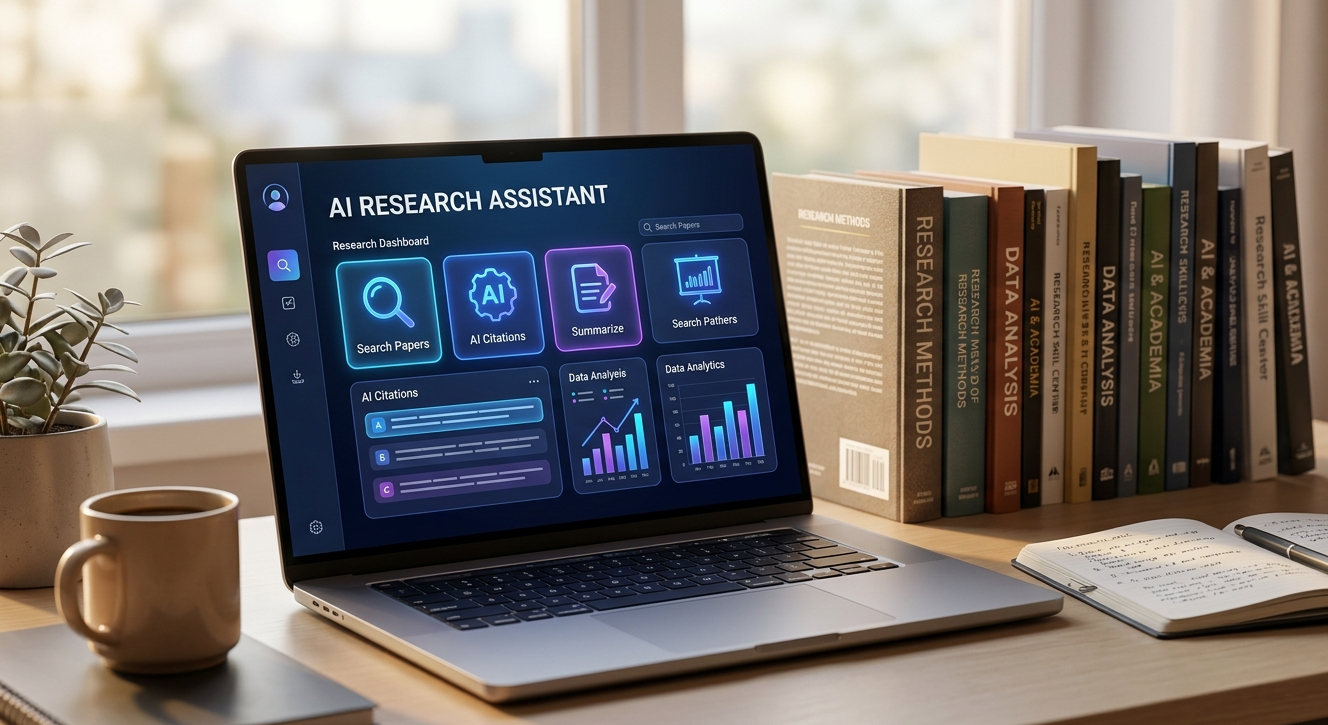
The world of academic research is changing at a lightning-fast pace. Gone are the days when students had to spend countless hours in libraries or scroll through hundreds of irrelevant Google search results. In 2026, Artificial Intelligence has become the ultimate Research Assistant, helping students organize, analyze, and write their papers with incredible speed and accuracy.
However, with so many AI tools available, it can be confusing to choose the right one. Not all AI tools are built for academic work some might provide incorrect facts or hallucinations. That is why choosing specialized AI Research Assistants is essential for any student who wants to maintain high grades while saving time.
In this guide, we will explore the top 7 AI tools that are currently dominating the academic world. These tools will help you from the initial stage of finding a research topic to the final stage of perfecting your citations.
1. Consensus: The Search Engine for Science
Finding a reliable source is the hardest part of research. Consensus is a specialized search engine that uses AI to find answers directly from peer-reviewed scientific research papers.
- Evidence-Based: It only provides answers that are backed by published studies.
- Simple Interface: You can ask a question like Does Vitamin C improve skin? and it will give you a summary of what the latest research says.
- Trustworthy: It reduces the risk of fake information because it links every claim to a real paper.
2. Perplexity AI: The Ultimate Search Companion
Think of Perplexity AI as a smarter version of Google. Instead of giving you a list of websites, it writes a detailed answer to your question while citing exactly where the information came from.
- Real-Time Citations: Every sentence includes a small number (source link) so you can verify the facts.
- Latest Info: Unlike some AI models that have a cutoff date, Perplexity searches the live internet.
- Pro Mode: It can help you narrow down complex topics into simple bullet points.
3. Elicit: Your Literature Review Expert
If you are writing a thesis or a long research paper, Elicit is a life-saver. It is designed to automate the most boring parts of the research process, specifically the literature review.
- Automatic Summaries: Upload or search for papers, and Elicit will summarize the key findings for you.
- Data Extraction: It can create tables showing the methodology, results, and participant counts of different studies.
- Efficiency: It helps you decide which papers are worth reading in full and which ones you can skip.
4. ChatPDF: Talk to Your Research Papers
Reading 50-page PDFs can be exhausting. ChatPDF allows you to upload any document and chat with it like a human assistant.
- Instant Answers: Ask, What are the main conclusions of this paper? and it will answer instantly.
- Page References: It tells you exactly which page it found the information on.
- Saves Time: Perfect for quickly understanding complex textbooks or long government reports.
5. Zotero with AI Plugins: Smart Citation Management
Zotero has always been a favorite for students, but in 2026, its AI plugins have made it even more powerful. It doesn’t just store your papers; it helps you understand them.
- Auto-Tagging: It organizes your library based on the topics discussed in the papers.
- Bibliography Generation: It creates citations in any style (APA, MLA, Harvard) with 100% accuracy.
- Seamless Integration: It works directly inside Microsoft Word and Google Docs.
6. Quillbot: The Professional Re-writer
Sometimes you have the right idea, but you can’t find the right words. Quillbot is a paraphrasing tool that helps you refine your writing to sound more academic and professional.
- Multiple Modes: Choose between Formal,Simple, or Creative tones.
- Plagiarism Prevention: It helps you rewrite sentences in your own voice (though you must still cite the source!).
- Grammar Checker: It catches subtle errors that standard spell-checkers miss.
7. Grammarly AI: Beyond Basic Spelling
Grammarly has evolved into a full-scale writing assistant. In 2026, it doesn’t just fix typos; it helps you structure your entire research argument.
- Tone Detection: It ensures your research paper sounds objective and professional, not emotional.
- Strategic Suggestions: It can suggest moving paragraphs or changing sentences to make your research flow better.
- Clarity Focus: It helps remove wordiness, making your writing clear and concise.
Conclusion
Using AI in your academic journey is no longer just an option; it is a necessity for staying ahead in 2026. These seven tools are designed to handle the time-consuming tasks of searching, formatting, and summarizing, allowing you to focus on what truly matters your original ideas and critical analysis. However, always remember that AI should be your assistant, not your replacement. Always double-check facts and ensure your final work reflects your own unique voice and hard work.
The best way to master these research assistants is to start using them one by one. Whether you are struggling with a complex literature review or just need to fix your citations, there is an AI tool ready to help. Explore these resources, simplify your study routine, and turn your research process into a much faster and more enjoyable experience. Your journey to becoming a pro researcher starts with a single click!
Frequently Asked Questions
1. Is it legal to use AI for academic research?
Yes, using AI for research is legal and widely accepted as long as you use it as a tool for assistance (like searching or summarizing) and not for generating entire papers. Always ensure that the final work is your own and that you cite your sources correctly to avoid plagiarism.
2. Which AI tool is best for finding scientific papers?
Consensus and Elicit are currently the best tools for scientific research. Unlike general AI, these tools are specifically connected to massive databases of peer-reviewed journals, ensuring that the information you get is scientifically accurate.
3. Can AI tools help me with citations (APA, MLA)?
Absolutely. Tools like Zotero and Perplexity AI are excellent for managing citations. They help you organize your sources and automatically generate bibliographies in various styles like APA, MLA, or Harvard with high precision.
4. Does ChatPDF store my private documents?
Most reputable AI tools like ChatPDF have strict privacy policies, but it is always a good habit not to upload highly sensitive or confidential personal data. For general research papers and textbooks, it is safe to use.
5. Will using AI make my writing sound robotic?
It can, if you copy-paste directly. To avoid this, use tools like Quillbot or Grammarly to refine your tone, but always give the final touch yourself. Your personal voice and critical thinking are what make a research paper truly great.