
What are AI shopping agents and how do they use your store?
AI shopping agents are smart programs that search, compare, and buy products on behalf of customers. They read your product data, prices, stock levels, and reviews through your website and APIs, then decide which items to recommend or purchase. If your store is not structured in a clear, machine‑friendly way, these agents will often skip it and choose a competitor instead.
Why e‑commerce stores must prepare for AI agents
More and more shoppers are using AI tools to research and buy products, often without ever clicking a Google search result. Stores that speak the language of AI agents through clean data, fast APIs, and rich product details get more visibility, better rankings, and higher conversion rates. Stores that ignore this shift risk losing traffic and sales to competitors who are AI‑ready.
How to expose real‑time inventory to AI agents
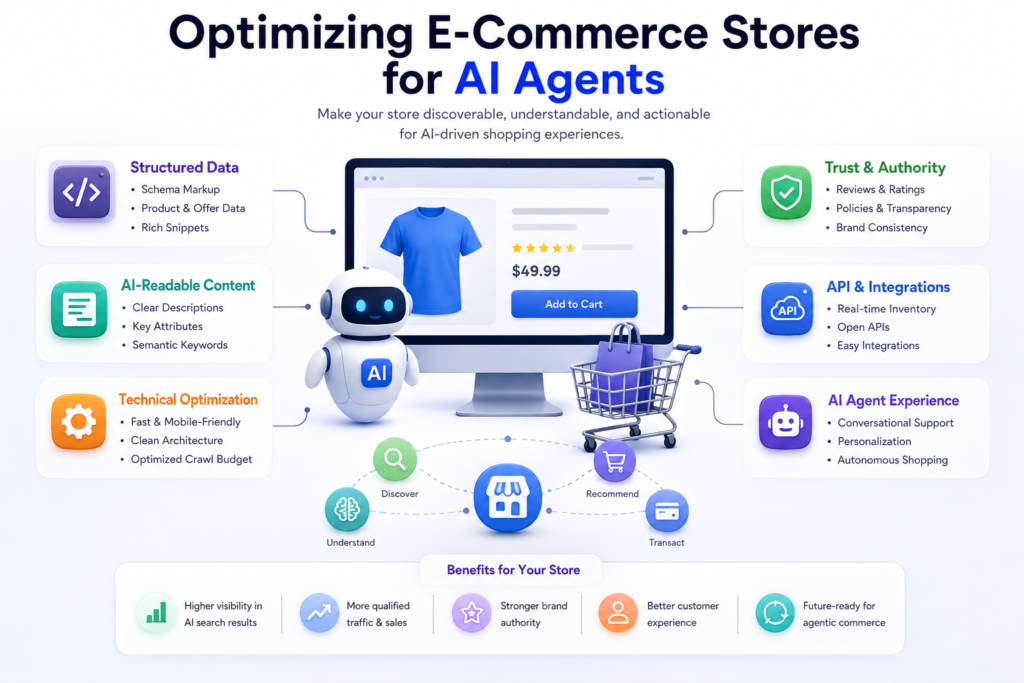
AI agents need live, accurate inventory data to trust your store. Open RESTful or GraphQL APIs that show real‑time stock levels, prices, and variants help agents make confident buying decisions. Avoid static feeds or manual CSV updates; instead, sync your warehouse, CMS, and marketplace so agents always see what is truly in stock and ready to ship.
How to structure product pages so AI agents understand them
AI agents parse pages quickly, so your product information must be simple, consistent, and well‑organized. Use clear headings, short bullet points for specs, and a logical layout that lists price, stock, delivery, and key features upfront. If your layout is messy or data is hidden inside images or JavaScript, agents will struggle to read your page and may pass it over.
Using schema markup so AI agents can discover your products
Schema markup is like a hidden label that tells AI agents exactly what your products are, what they cost, and how many are available. By adding Product, Offer, and Review schema in JSON‑LD format, you make your store easier for AI systems to understand and recommend. This small technical step can significantly improve your chances of appearing in AI‑powered answers and search overviews.
Building trust with AI agents through clear policies and compliance
AI agents prefer stores with clear shipping, return, and privacy policies because they reduce risk for the buyer. If your terms are confusing or missing, agents may avoid suggesting your store. Make sure your policies are easy to read, up to date, and compliant with local rules like GDPR or CCPA so AI systems feel confident linking or purchasing through your site.
Measuring AI agent traffic separately from human visitors
Many stores track “visitors” but do not separate human traffic from AI‑driven requests. To stay ahead, create a custom tracking rule in your analytics (for example, by filtering on specific user‑agent patterns or API‑based traffic) and label sessions that come from known AI tools or bots. This way you can see how many sales, form fills, or API calls come from agents versus real people, and adjust your product data, pricing, and UX specifically for AI‑friendly conversion.
How a mid‑size store improved AI visibility
A mid‑sized fashion store improved its AI visibility by adding structured product data, fixing broken APIs, and cleaning up its category pages. Within three months, those changes led to more agent‑driven traffic and higher conversion rates from AI‑assisted shoppers. The key lesson is that small technical fixes, like adding schema markup and fixing slow APIs, can give big results when AI agents visit your site.
Making your store ready for voice and visual‑search AI agents
Voice assistants and visual‑search tools are also powered by AI agents. To rank in voice search, make your product descriptions short, natural, and answer‑like. For visual search, use high‑quality images with clear alt‑text and simple filenames. When both text and images are clean and descriptive, AI systems can better match your products to what people are asking or showing.
Simple checklist for any store owner to start today
You don’t need a huge tech team to get started. First, add basic product schema, fix broken links, and make sure your prices and stock are up to date. Then, document or publish a simple API endpoint for your best‑selling products. These small steps will already make your store more visible and friendly to AI agents, even if you are a small or medium‑sized business.
FAQ section
- What is the easiest way for a small store to become AI‑agent‑friendly?
Start with clean product pages, good schema markup, and accurate stock information. These small changes make it much easier for AI systems to understand and recommend your store. - Do I need an API to work with AI shopping agents?
A simple, documented API for product and inventory data makes life much easier for AI agents, but even without a full API, clear on‑page data and structured markup can still help. - How can I tell if AI agents are visiting my store?
Check your server logs or analytics for unusual non‑browser traffic patterns, or add custom tracking rules for known AI‑related bots and tools. Over time you will see which pages AI systems are most interested in. - Can AI agents replace my human support team?
AI agents can handle many routine questions and tasks, but they work best as helpers, not full replacements. Keep a human team for complex issues, trust‑building, and emotional support. - Will optimizing for AI agents hurt my “normal” organic traffic?
No. Making your store AI‑friendly usually improves SEO too, because you are adding clearer structure, better data, and faster pages things Google and other search engines also like.