
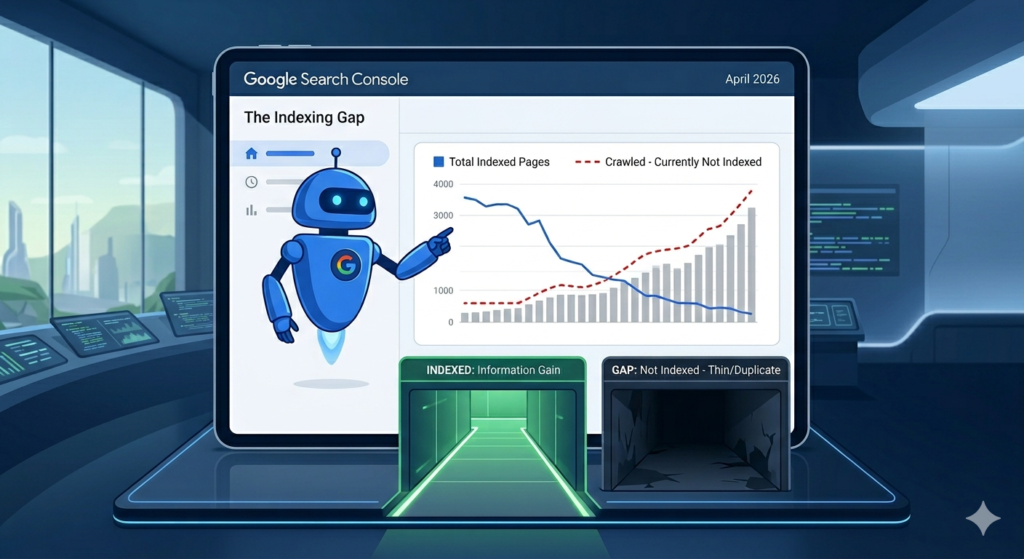
In the fast-evolving landscape of 2026, many webmasters are facing a frustrating paradox: they are producing what they believe is high-quality content, yet Google Search Console continues to report a rising number of pages as “Crawled – currently not indexed.” This “Indexing Gap” marks a fundamental shift in how search engines operate. With the explosion of AI-generated text flooding the web, Google has moved from a philosophy of “index everything” to a much more selective model. Simply being “good” is no longer the entry fee; your content now has to prove it provides a unique value that the search engine hasn’t already archived a thousand times over.
The truth is that the “Indexing Gap” is rarely a technical glitch and more often a quality threshold issue. As Google’s AI Overviews become the primary way users consume information, the search engine has become incredibly protective of its “Render Budget” and storage space. If a page doesn’t offer a high Information Gain Score or clear Topical Authority, Google will crawl it to see what’s there, but it will choose not to serve it to users. Understanding why this gap exists—and how to bridge it—is the most critical skill for any SEO expert or startup founder in 2026.
Understanding the Render Budget in 2026
In the past, we talked about Crawl Budget, but today the focus has shifted to the Render Budget. Google can crawl billions of pages, but rendering them actually processing the JavaScript, analyzing the layout, and understanding the context costs significant computing power.
- The Selective Crawler:
Google’s AI-driven bots now perform a “pre-scan.” If the initial scan of your HTML shows patterns identical to millions of other blogs, the bot stops before the heavy rendering process begins.
- The Cost of “Me-Too” Content:
If your blog post covers Top 10 Skincare Tips and uses the same advice found on WebMD or Healthline, Google views rendering your page as a waste of resources. This leads directly to the “Crawled – currently not indexed” status.
The Rise of the Information Gain Score
One of the most important LSI concepts in 2026 is Information Gain. This is a mathematical way Google determines if your page adds new data to its index.
Why Your Content Might Be Failing:
- Regurgitated AI Content:
If you use AI to summarize existing articles, your Information Gain score is zero. - Lack of Unique Data:
To break the indexing gap, you need “Originality Signals.” This could be a unique case study, a personal experiment, or a set of original images. - Entity Under-Optimization:
If your content doesn’t clearly define the Entities it’s talking about, the AI doesn’t know where to “slot” your information into its knowledge graph.
Technical Bottlenecks: When it Is Your Site’s Fault
While quality is usually the culprit, technical issues can still trigger indexing delays. In 2026, the relationship between your Internal Link Architecture and the Indexation API is vital.
| Technical Factor | Why it Triggers the Gap | The 2026 Fix |
| Orphan Pages | Pages with no internal links are seen as low-priority. | Use a Hub and Spoke internal linking model. |
| Slow Rendering | If your Astra theme or plugins load too slowly, the bot times out. | Optimize Core Web Vitals and use a lightweight CDN. |
| JavaScript Heavy | Googlebot might struggle to see your content if it’s hidden behind complex scripts. | Use Server-Side Rendering (SSR) for critical text. |
4. How to Bridge the Gap: A Step-by-Step Recovery Plan
If your Search Console is full of excluded pages, you need a systematic approach to force Google’s hand.
Step 1: Audit for Content Decay
Go through your non-indexed URLs. Are they too short? Are they outdated? In 2026, Thin Content is an instant trigger for the indexing gap. If a post is under 800 words and doesn’t have a specific purpose, either delete it or merge it into a larger Pillar Page.
Step 2: Implement the Indexation API
For startup founders and fast-moving sites, waiting for a natural crawl isn’t enough. Use tools that connect directly to Google’s Indexing API. This doesn’t guarantee a permanent spot in the index, but it forces Google to render the page immediately, giving you a chance to prove its value.
Step 3: Boost Topical Authority
Google indexes sites it trusts. If you are writing about Digital Monetization, but your site also has random posts about Travel and Cooking, you are diluting your Niche Authority. Stick to your Semantic Cluster.
Strategic Internal Linking and “Seed Pages”
Google finds new content through “Seed Pages”—high-authority pages on your site that are already indexed and frequently crawled.
- The Leapfrog Method: Find your top 5 best-performing pages. Add a natural, contextually relevant link from those pages to your “Crawled – currently not indexed” URLs.
- Anchor Text Diversity: Don’t just use “click here.” Use descriptive, semantic anchor text that explains the Entity relationship. For example: “For more on resolving 301 redirect loops, see our technical guide.”
The Role of User Signals and Social Proof
In 2026, Google uses “proxy signals” to decide if a page is worth the space in its index. If a page gets zero traffic from social media, zero clicks from newsletters, and zero mentions online, Google assumes it’s a “dead” page.
- Drive Initial Traffic: Share your new URLs on LinkedIn, Twitter, or specialized forums. Even a small amount of human traffic can “wake up” the crawler and signal that the page is relevant to real users.
- Encourage Engagement: Comments and long “Dwell Time” (how long someone stays on the page) tell Google that the content is high-quality, pushing it from “Crawled” to “Indexed.”
Formatting for the AI Crawler
To escape the indexing gap, make your content as easy as possible for an AI to read. Use Semantic HTML and clear structures.
The Perfect 2026 Blog Structure:
- H1: Clear, entity-rich title.
- Intro: 2 passages max, stating the “Thesis Statement” clearly.
- H2/H3: Question-based headings.
- Lists/Tables: Break up data so the AI can extract snippets for Overviews.
- Schema Markup: Use Article and FAQ schema to give the bot “hints” about what the page contains.
Conclusion: Persistence is the New SEO
The Indexing Gap is Google’s way of cleaning up the web. To beat it, you must stop thinking like a content generator and start thinking like a Knowledge Provider. Focus on Information Gain, tighten your Internal Linking, and ensure your Technical SEO is flawless.
When you provide a unique answer to a real human intent, Google cannot afford to keep you out of the index. The gap will close, and your rankings will follow.
Are you seeing these indexing issues on your main domain or across your entire portfolio of niche sites?
Frequently Asked Questions
Q1: Why is my content “Crawled – currently not indexed” despite being high quality?
In 2026, Google uses a “Render Budget” to save resources. Even if your content is good, if it doesn’t provide enough Information Gain (unique value) compared to existing pages, Google may crawl it but choose not to add it to the index.
Q2: How long does it take for Google to move a page from “Crawled” to “Indexed”?
There is no fixed timeline. It can take anywhere from a few days to several weeks. You can speed up this process by improving internal linking from “Seed Pages” and using the Google Indexing API.
Q3: Does AI-generated content cause indexing issues?
AI content itself isn’t the problem, but unedited AI content often lacks original insights. If the AI simply repeats what is already on the web, Google will flag it as “low value” and refuse to index it.
Q4: Can a 301 redirect help fix indexing gaps?
Yes. If you have an old, indexed page that is similar to the new, non-indexed one, a 301 redirect can pass the “authority” to the new URL, signaling to Google that the content is important.
Q5: Does site speed affect indexation in 2026?
Absolutely. If your page takes too long to render, the Googlebot may time out during the crawl, leading to the “currently not indexed” status. Optimizing Core Web Vitals is essential.