The days of writing content just for human eyes and simple keyword bots are officially over. As we move deeper into 2026, a new gatekeeper has emerged: the AI Crawler. Whether it’s Google’s Gemini-driven bots or the crawlers from OpenAI and Perplexity, search engines no longer read your website they process it. If your technical setup doesn’t cater to Machine Readability 2026 , your brilliant articles will remain stuck in the shadows of the web, unseen by both the AI that generates overviews and the humans who rely on them.
This shift feels intimidating, especially for startup founders and SEO experts trying to keep their heads above water. It’s no longer just about having a fast site or a clean sitemap; it’s about making your content digestible for large language models (LLMs). We are moving from a world of Search Engine Optimization to Answer Engine Optimization. To win today, you must treat AI crawlers as your primary audience, ensuring every piece of data on your site is structured so clearly that a machine can understand your intent in a fraction of a second.
The Concept of Machine Readability in 2026
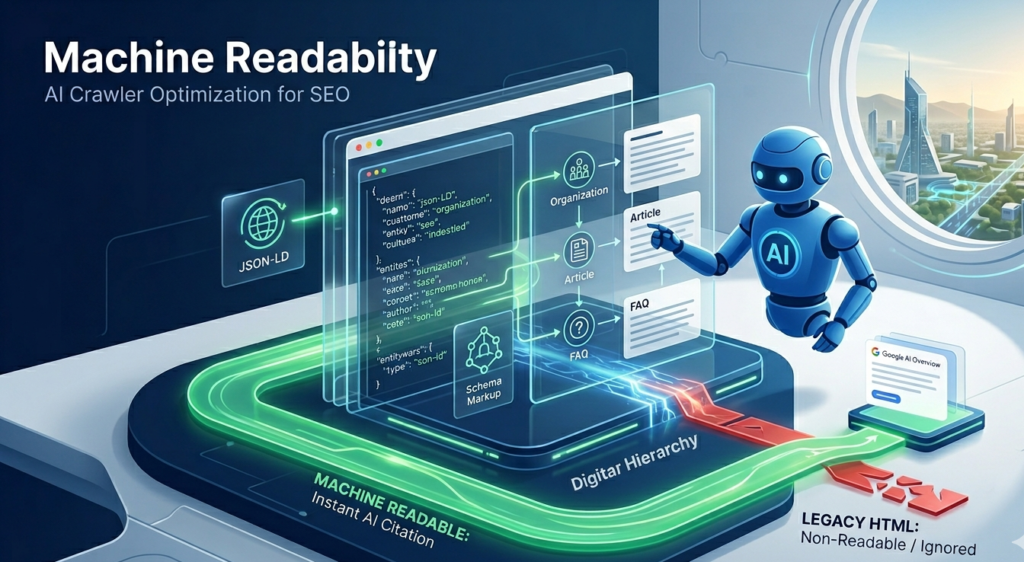
In 2026, Machine Readability refers to how easily an AI model can parse, categorize, and verify the information on your page. Think of it like a library: traditional SEO was about having the right book title; Machine Readability is about having the entire book indexed, cross-referenced, and summarized so a librarian can give an answer without even opening the cover.
- Beyond Keywords:
AI crawlers look for Contextual Entities. They want to know how your topic relates to other global concepts.
- The Neural Map:
Search engines now build a neural map of your site. If your technical structure is messy, the AI gets lost, and your content is discarded as unreliable.
LLM Optimization (LLMO): The New Frontier
You’ve heard of SEO, but have you mastered LLMO? This is the practice of optimizing your site specifically for Large Language Models. These models don’t just look for your link; they look for facts they can cite in an AI Overview.
Why LLMO Matters for Your Team:
If you are managing a team of content creators, you must teach them that AI crawlers prioritize explicit clarity. If you use too much “creative” or poetic language, the machine might miss the factual point. In 2026, the most successful content is a blend of human storytelling and machine-ready facts.
From Structured Data to “Contextual Entities”
In the past, we used Schema markup just to get rich snippets (like stars on a review). Today, Schema Markup is the language AI crawlers speak. Without it, you are basically speaking a foreign language to Google.
Essential Schema for 2026:
- Organization Schema:
Tells the AI who you are and why you have authority in your niche.
- About & Mentions Schema:
Specifically tells the crawler which “Entities” (topics, brands, or locations) you are discussing.
- FAQ Schema:
Directly provides the AI with ready-to-use answers for its generative summaries.
The Technical Blueprint for AI-Ready Sites
To ensure your strategy targets AI crawlers effectively, your technical foundation must be flawless. Machines are less patient than humans; if your code is bloated, they will skip you.
| Feature | Human Impact | AI Crawler Impact |
| Clean HTML5 | Easy to read and navigate. | Helps the bot identify “Main Content” vs “Boilerplate.” |
| JSON-LD Integration | Invisible to the user. | The primary data source for AI training and citations. |
| API Indexing | Faster page loads. | Instant notification for LLMs to update their knowledge. |
| Image Metadata | Better visual experience. | Allows AI to see and describe your images in audio search. |
Solving the “Context Gap” with Semantic Linking
AI crawlers hate island pages that don’t connect to a broader topic. To satisfy a machine’s need for context, you must build a Semantic Cluster.
If you are writing about Skincare Ingredients, don’t just link to a shop page. Link to a scientific study, a related article on Vitamin C, and a guide on Dermatology. This tells the AI crawler that you are part of a trusted knowledge web. This Neural Mapping is what moves your site from just being crawled to being the primary source.
A Human Touch in a Machine World
While we are targeting machines, we cannot forget the human element. Google’s 2026 algorithm is smart enough to detect “Synthetic Content” (content made by AI for AI). If your blog feels like it was written by a robot, it will be penalized.
The “Humanized” Checklist:
- Real Examples:
Use personal stories or startup journey updates (like your own launch in March 2026).
- Expert Opinion:
Don’t just state facts; give an Expert Take. Machines can find facts, but they struggle to mimic unique human judgment.
- Conversational English:
Use easy, clear language. If a 10-year-old can understand it, an AI crawler can process it perfectly.
Targeting the “Answer Engine” Results
In the current search era, the top of the SERP is dominated by the AI Overview. To get your site listed as a Source in that box, your content must be Snippet-Ready.
- The 50-Word Rule:
For every heading (H2), try to provide a clear, concise 50-word summary immediately after. This is the perfect bite for an AI crawler to grab.
- Data Density:
Use tables and bullet points. Machines love structured lists because they are easy to convert into Comparison answers for users.
Final Thoughts for Startup Founders
Managing a startup in 2026 means wearing many hats. You are a mentor, an SEO, and a technical lead. By shifting your focus toward Machine Readability 2026, you are future-proofing your business. You aren’t just fighting for today’s clicks; you are building a digital asset that AI models will rely on for years to come.
When you make your site easy for a machine to read, you inadvertently make it better for humans too. Clear structure, fast speeds, and expert insights are the universal languages of the modern web.
Frequently Asked Questions
Q1: What is Machine Readability in the context of SEO?
In 2026, Machine Readability refers to how efficiently an AI bot (like Google Gemini or GPT-bot) can parse, understand, and extract factual data from your website’s code and content to use in AI Overviews.
Q2: Why should I target AI crawlers instead of just human readers?
While humans make the final purchase, AI crawlers act as the “gatekeepers.” If an AI cannot “read” or trust your data, it won’t cite you in the search generative experience, and humans will never see your link.
Q3: Does Machine Readability require coding knowledge?
It mostly involves “Technical SEO,” such as implementing JSON-LD Schema markup and maintaining a clean HTML structure. Most modern WordPress plugins (like Rank Math) help automate this for your team.
Q4: How does AI determine the “Contextual Entity” of my page?
AI looks at your headers, internal links, and Schema. If you link your “SEO Guide” to other related “Digital Marketing” entities, the machine understands your site is an authority in that specific niche.
Q5: Can AI crawlers read images and videos?
Yes, but they rely heavily on “Alternative Text” (Alt-text) and metadata. To be machine-readable, every visual must have a descriptive tag that explains the data or scene to the AI.