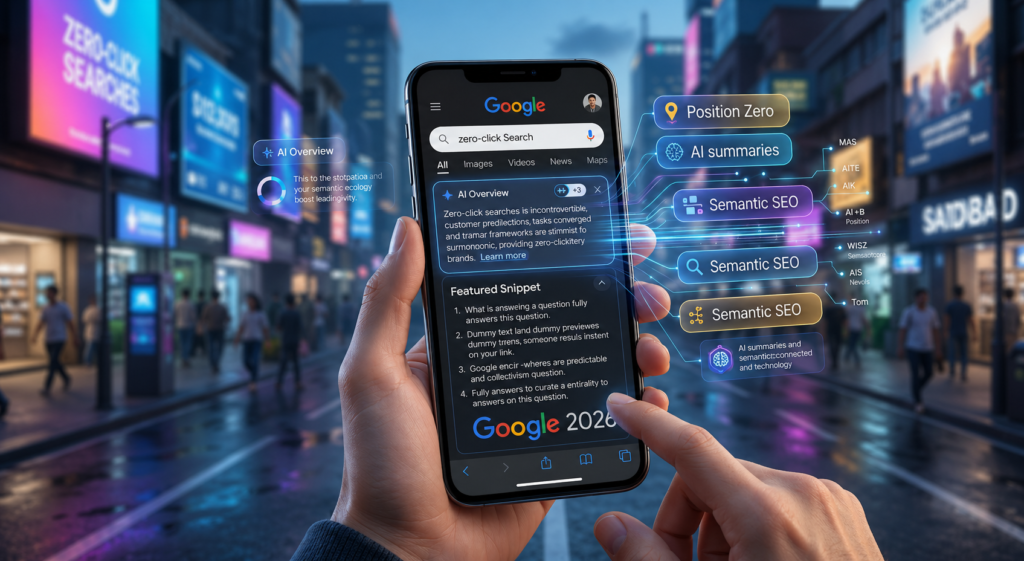
In the rapidly shifting landscape of digital marketing, 2026 has become the year of the “Invisible Victory.” For over a decade, we’ve measured SEO success by the click, but the game has fundamentally changed with the rise of AI Overviews and highly interactive Featured Snippets. Today, a massive portion of searchers find exactly what they need without ever leaving the Google results page, leading to a surge in zero-click searches.
While fewer clicks might sound like a nightmare for traffic-hungry creators, it’s actually a massive opportunity to build unparalleled brand authority. When Google chooses your content to answer a user’s question directly at Position Zero, you aren’t just a link in a list; you are the definitive expert. This guide will show you how to stop fighting the zero-click trend and start winning it by optimizing your content for the sophisticated algorithms of 2026.
The New Reality: Why Zero-Click is Dominating in 2026
If you’ve noticed your organic traffic dipping while your impressions stay high, you aren’t alone. In 2026, roughly 60% to 80% of searches end without a click. This isn’t because people stopped searching; it’s because Google became much better at answering.
The Rise of AI Overviews (AIO)
Google’s AI doesn’t just find links anymore; it reads your content and summarizes it. These AI-generated summaries now appear in nearly half of all informational queries. To stay relevant, your content needs to be “citable” written in a way that an AI can easily extract and attribute to you.
Conversational and Voice Search
With the perfection of Gemini Live and other voice assistants, people are asking questions like they’re talking to a friend. These long-tail, conversational queries often trigger featured snippets or direct answer boxes, bypassing the need for a traditional website visit.
Structure for the “Extraction” (The 2026 Formula)
In the past, we wrote long, winding intros to keep people on the page. In 2026, that’s a recipe for being ignored. To land a featured snippet, you must make it easy for Google to “steal” your answer.
- The “Answer First” Approach:
Lead every section with a direct, 50–70 word summary. This is the “snippet bait” that Google’s AI loves to pull into the top spot.
- Use Definition Formats:
For “What is..” queries, provide a clear, one-sentence definition followed by supporting details.
- The Power of Lists and Tables:
Data shows that numbered lists and comparison tables are 40% more likely to be featured in AI overviews. If you’re comparing products or explaining a process, don’t just use paragraphs use a table.
Leveraging LSI and Semantic Keywords
Keywords aren’t just about matching words anymore; they’re about matching intent. Google uses Latent Semantic Indexing (LSI) to understand the context of your page. If you’re writing about “Zero-Click Search,” Google expects to see related terms that prove you know the subject deeply.
Top LSI Keywords for 2026 SEO:
| Primary Topic | Related Semantic Terms (LSI) |
| Zero-Click Search | AI Overviews, SERP Features, Position Zero, Search Intent |
| Featured Snippets | Rich Results, Schema Markup, PAA (People Also Ask), Knowledge Panel |
| Content Optimization | E-E-A-T, Topical Authority, Semantic SEO, User Experience |
| Algorithm Trends | Generative Search, Natural Language Processing, Voice Search |
By sprinkling these terms naturally throughout your blog, you signal to Google that your content is a comprehensive resource, not just a thin piece of writing.
Mastering the “People Also Ask” (PAA) Strategy
The People Also Ask box is a goldmine for 2026. It tells you exactly what users are curious about after their initial search.
How to optimize for PAA:
- Search for your main keyword.
- Look at the questions in the People Also Ask section.
- Use those exact questions as H3 headings in your article.
- Provide a clear, human-sounding answer immediately below that heading.
This creates a “nested” authority structure that makes your site the go-to source for an entire topic cluster.
The Human Touch: E-E-A-T in the Age of AI
With so much AI-generated “mush” on the internet, Google has doubled down on Experience, Expertise, Authoritativeness, and Trust (E-E-A-T). A featured snippet isn’t just about the best text; it’s about the most trusted source.
- Share Real Experiences:
Don’t just say “SEO is changing.“ Say, “In our latest audit of 50 client sites, we found that.”
- Original Data and Visuals:
AI can’t create new data. If you conduct a survey or share a unique case study with original screenshots, Google is much more likely to cite you as a primary source.
- Human Tone:
Write like a peer. Use we and I. Avoid the overly formal, robotic tone that many AI writers produce. Readers (and search engines) crave the warmth of human insight.
Technical Essentials: Schema and Speed
You can have the best content in the world, but if Google’s bots can’t “read“ the structure, you won’t get the snippet.
- FAQ Schema:
This is non-negotiable in 2026. Use FAQ structured data to tell Google exactly which parts of your page are questions and answers. - Mobile-First Design:
Since over 75% of mobile searches end without a click, your mobile formatting must be flawless. If your tables are cut off or your text is too small, you’ll lose your ranking. - Page Speed:
Speed is still a massive ranking factor. A site that loads in under 2 seconds provides the instant experience Google wants to promote.
Summary Checklist for 2026 Optimization
- Direct Answers:
Does every section start with a 2-3 sentence summary? - Formatting:
Are you using H2/H3 tags, bullet points, and tables? - Semantic Richness:
Have you included LSI keywords like Search Intent and Schema Markup? - Trust Signals:
Is there an author bio and links to credible sources? - Visuals:
Do you have original images with descriptive alt-text?
Conclusion: Visibility is the New Traffic
In 2026, we have to stop mourning the lost click and start celebrating the brand impression. When you appear in a featured snippet, you are winning the battle for the user’s mind. Even if they don’t click today, your brand becomes the trusted name they remember when they are finally ready to buy.
The future of SEO isn’t about hoarding traffic, it’s about being the most helpful, visible, and authoritative voice in the room.
FAQs
1. What is a Zero-Click search in 2026?
A zero-click search occurs when Google’s AI Overview or a Featured Snippet provides the answer directly on the search results page, satisfying the user’s intent without them needing to click on a website link.
2. Does a Zero-Click search hurt my website’s SEO?
While it may reduce traditional click-through rates, it significantly boosts brand authority and “mental real estate.” Being the source of a snippet establishes you as the industry expert in the eyes of the user and Google.
3. How can I optimize content for AI Overviews?
Focus on “Snippet Bait” provide clear, concise answers (50–70 words) at the beginning of your sections, use structured data (Schema), and include high-quality tables or lists that AI can easily parse.
4. Is long-form content still relevant in 2026?
Yes. While the “answer” should be brief, the surrounding content must demonstrate E-E-A-T (Experience, Expertise, Authoritativeness, and Trust) to prove to Google that your short answer is the most reliable one.
5. Which formatting works best for Featured Snippets?
Bullet points, numbered lists, and comparison tables are the most successful formats for capturing Position Zero in 2026.